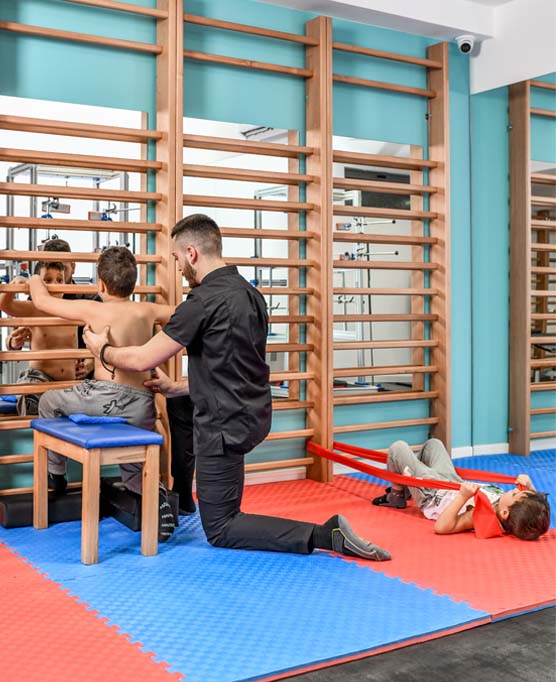
The entire concept originated in Germany, at the Asklepios Clinic, where the method has been developed and preserved for many years. Children go through phases of rapid growth and development as they grow up. In girls, this period usually coincides with menarche, while in boys, the first period of rapid growth corresponds with voice mutation.
In principle, scoliosis develops idiopathically. The cause of its onset is unknown. However, improper posture, emphasis on one leg, carrying a bag on one shoulder, only worsen the existing asymmetry during the growth and development period. Typically, scoliosis may be associated with pes planus – flatfoot deformity, but there is no study stating that flat feet can provoke the development of curvature.
Parents most often notice improper posture, shoulder imbalance, prominent hip in their children. Scoliosis as a deformity is always observed through three planes.
During clinical examination, the position of the feet, Achilles tendons, valgus or varus position of the knees, position of the iliac bones, prominent hip, asymmetry of the growth triangles (Lorenz triangle), shoulder imbalance, shoulder protraction and retraction are taken into account. In Adam’s forward bend test, speaking of a positive test, we see a rib hump on the convex side of the thoracic curve, whose rotation degree is measured with a scoliometer.
On the concave side, in the thoracic region, we notice the weak side where the ribs are positioned rotated forward, and the scapula and shoulder are retracted. In the cervicothoracic region, if there is a curve, a “shoulder hump” rib hump is observed. With a greater degree of forward bending in the lumbar region, a lumbar prominence and a weak point are noticed. Examination is also performed from the side and the front. From the side, we again notice the complete body position, and what is most often present is the “flat back” with straightened physiological curves of the spine and hyperlordosis of the sacroiliac part. From the front, ventral prominence (rib hump) is observed opposite the weak side, as well as the ventral flat zone opposite the rib hump.
On the concave side, in the thoracic region, we notice the weak side where the ribs are positioned rotated forward, and the scapula and shoulder are retracted. In the cervicothoracic region, if there is a curve, a “shoulder hump” rib hump is observed. With a greater degree of forward bending in the lumbar region, a lumbar prominence and a weak point are noticed. Examination is also performed from the side and the front. From the side, we again notice the complete body position, and what is most often present is the “flat back” with straightened physiological curves of the spine and hyperlordosis of the sacroiliac part. From the front, ventral prominence (rib hump) is observed opposite the weak side, as well as the ventral flat zone opposite the rib hump
After a detailed examination, all necessary parameters are determined through a fresh X-ray. By presenting a detailed diagram and body blocks, we illustrate the way of resolving the existing scoliosis. The treatment primarily consists of establishing the correct Schroth classification, based on which a treatment plan is determined – corrective positions for the existing deformity. In these positions, through various variations, asymmetric exercises are applied with increased tension by breathing. This concept resolves scoliosis three-dimensionally, and it can rightfully be said that Schroth is the best method for achieving noticeable results.