Schroth Method

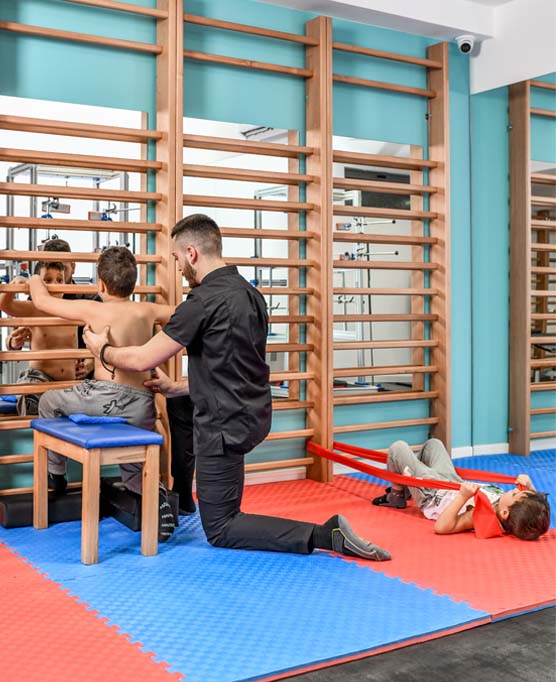
The Schroth method is a unique treatment concept for correcting spinal deformities. Its three-dimensional approach in treating scoliosis has shown the best results in conservative treatment of this persistent problem.

Schroth Method

The Schroth method is a unique treatment concept for correcting spinal deformities. Its three-dimensional approach in treating scoliosis has shown the best results in conservative treatment of this persistent problem.

The entire concept originated in Germany, at the Asklepios Clinic, where the method has been developed and preserved for many years. Children go through phases of rapid growth and development as they grow up. In girls, this period usually coincides with menarche, while in boys, the first period of rapid growth corresponds with voice mutation.

 In principle, scoliosis develops idiopathically. The cause of its onset is unknown. However, improper posture, emphasis on one leg, carrying a bag on one shoulder, only worsen the existing asymmetry during the growth and development period. Typically, scoliosis may be associated with pes planus – flatfoot deformity, but there is no study stating that flat feet can provoke the development of curvature.

Parents most often notice improper posture, shoulder imbalance, prominent hip in their children. Scoliosis as a deformity is always observed through three planes.

During clinical examination, the position of the feet, Achilles tendons, valgus or varus position of the knees, position of the iliac bones, prominent hip, asymmetry of the growth triangles (Lorenz triangle), shoulder imbalance, shoulder protraction and retraction are taken into account. In Adam’s forward bend test, speaking of a positive test, we see a rib hump on the convex side of the thoracic curve, whose rotation degree is measured with a scoliometer.

On the concave side, in the thoracic region, we notice the weak side where the ribs are positioned rotated forward, and the scapula and shoulder are retracted. In the cervicothoracic region, if there is a curve, a “shoulder hump” rib hump is observed. With a greater degree of forward bending in the lumbar region, a lumbar prominence and a weak point are noticed. Examination is also performed from the side and the front. From the side, we again notice the complete body position, and what is most often present is the “flat back” with straightened physiological curves of the spine and hyperlordosis of the sacroiliac part. From the front, ventral prominence (rib hump) is observed opposite the weak side, as well as the ventral flat zone opposite the rib hump.

On the concave side, in the thoracic region, we notice the weak side where the ribs are positioned rotated forward, and the scapula and shoulder are retracted. In the cervicothoracic region, if there is a curve, a “shoulder hump” rib hump is observed. With a greater degree of forward bending in the lumbar region, a lumbar prominence and a weak point are noticed. Examination is also performed from the side and the front. From the side, we again notice the complete body position, and what is most often present is the “flat back” with straightened physiological curves of the spine and hyperlordosis of the sacroiliac part. From the front, ventral prominence (rib hump) is observed opposite the weak side, as well as the ventral flat zone opposite the rib hump

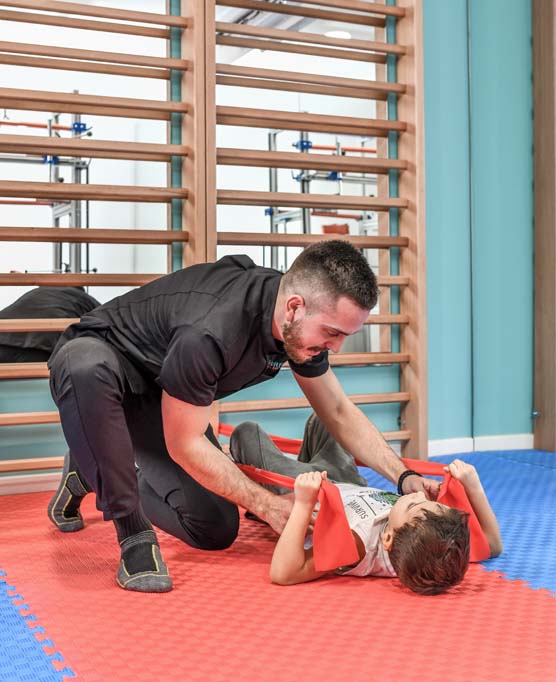
After a detailed examination, all necessary parameters are determined through a fresh X-ray. By presenting a detailed diagram and body blocks, we illustrate the way of resolving the existing scoliosis. The treatment primarily consists of establishing the correct Schroth classification, based on which a treatment plan is determined – corrective positions for the existing deformity. In these positions, through various variations, asymmetric exercises are applied with increased tension by breathing. This concept resolves scoliosis three-dimensionally, and it can rightfully be said that Schroth is the best method for achieving noticeable results.
Schedule your appointment today

Sticky Button Phone Icon
Scroll to Top

Dr Ljubica Ružić

Specialist in Physical Medicine and Rehabilitation

Dr. Ljubica Ružić graduated from the Faculty of Medicine at the University of Belgrade in 1998. She completed her specialization in physical medicine and rehabilitation in 2004 at the Military Medical Academy (VMA) in Belgrade, where she obtained the title of specialist in this field.

She began her professional career as a general practitioner at the Tivat Health Center in 1998, then worked at the Kotor General Hospital, and from 2000 to 2025 she was employed at the Meljine General Hospital (now the Kotor Clinical Hospital Center), where from 2004 she worked as a specialist in physical medicine and rehabilitation..

Throughout her long career, she has continuously pursued professional development through numerous trainings and professional conferences, with a particular focus on mesotherapy in pain management, the application of intra-articular injections in the treatment of osteoarthritis, and modern EMM-Tech technologies.

dr Srebra Golubović

Specialist in Physical Medicine and Rehabilitation

Dr Srebra Golubović graduated from the Faculty of Medicine, University of Belgrade in 1997, and completed her specialization in Physical Medicine and Rehabilitation in 2004 at the Clinic for Physical Medicine and Rehabilitation in Niš.

She began her professional career in Serbia, where she worked for 12 years at the Special Hospital for Orthopedic and Osteoarticular Diseases “Ribarska Banja.”

Since 2017, she has been developing her expertise in Kuwait, where she has spent the past 8 years working in renowned healthcare institutions – Hadi Hospital, ATP Global Med, and Medcap Clinic.

She has continuously advanced her knowledge through numerous trainings and international congresses across Europe and Asia, gaining extensive experience in the diagnosis and treatment of joint and soft tissue disorders, pain management with laser therapy, ultrasound diagnostics, intra-articular injections, as well as in the assessment and treatment of osteoporosis.

Dr Golubović is recognized for her professional and dedicated approach to patients, aiming to provide each person with faster recovery, pain relief, and a return to a better quality of life.

dr Marina Vuković

Specialist in Physical Medicine and Rehabilitation

Dr Marina Vuković graduated from the Faculty of Medicine in Belgrade in 2008 and completed her specialization in physical medicine and rehabilitation in 2016.

With 15 years of experience working at the Clinical Center of Montenegro, as well as in private practice, Dr Vuković brings exceptional expertise and knowledge to our team. She is dedicated to providing the highest quality care and support to patients during rehabilitation.

She has advanced her skills in pain mesotherapy and is the first female doctor in Montenegro to work with robotic rehabilitation of neurological patients.

dr Milena Adžić

Specialist in Physical Medicine and Rehabilitation, Subspecialist in Pediatric Physiatry

Dr Milena Adžić graduated from the Faculty of Medicine in Novi Sad and completed her specialization in physical medicine and rehabilitation at the Faculty of Medicine in Belgrade. She further directed her professional path by completing a subspecialization in pediatric physiatry at the Faculty of Medicine in Belgrade, gaining a deep understanding of the specific needs of the youngest patients.

Her many years of work experience include positions at institutions such as the Health Center in Cetinje, the “Dr Simo Milošević” Institute in Igalo, the Center for Physical Medicine and Rehabilitation at the Clinical Center of Montenegro, and the Institute for Diseases of Children at the Clinical Center of Montenegro.

She continuously advances her expertise through numerous specialized trainings. She has completed Kinesiological Diagnostics of Infants according to the Vojta method at the Academy for Developmental Rehabilitation in Zagreb, as well as training in the Assessment of the Quality of General Movements (GM). In addition, Dr Adžić has completed Advanced NRT Bobath Baby training in Slovenia, according to EBTA principles, and training in Three-Dimensional Scoliosis Treatment based on the Schroth method in Split.